Pro Fire Damage RestorationPro Fire Damage Restoration

Dry & Wet Soot Removal los angeles

Dry and wet soot require distinct operational methodologies based on how combustion occurred. Fast-burning, high-temperature fires fueled by dry wood or paper create dry soot, leaving a powdery, low-moisture residue.…
Get My Free Estimate →(657) 530-4053
Dry & Wet Soot Removal in los angeles, CA
Quick answer
  • What is included: Particulate assessment, dry chemical sponge wiping, wet alkaline solvent washing, HEPA vacuuming, and negative air scrubbing.
  • Deployment speed: Mobilization within 60 to 120 minutes across Los Angeles County following site clearance by first responders.
  • Ballpark cost: Service starts at an entry minimum of $250, with full-room restorations ranging between $1,800 and $4,500 depending on fuel source and square footage.
  • Materials treated: Porous drywall, hardwood framing, masonry, ceramic tile, HVAC ductwork, and structural subflooring.
  • How to schedule: Call (657) 530-4053 for priority dispatch or to request an immediate on-site structural triage evaluation.

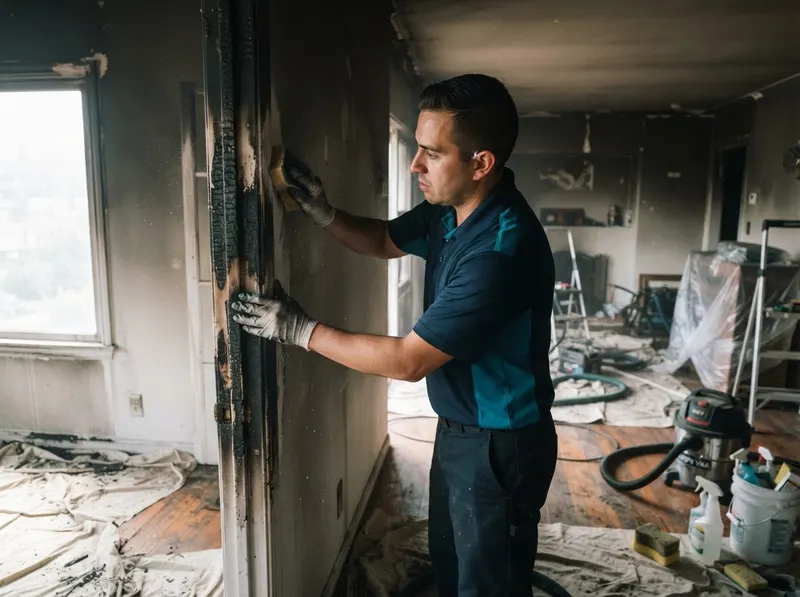
Dry and wet soot require distinct operational methodologies based on how combustion occurred. Fast-burning, high-temperature fires fueled by dry wood or paper create dry soot, leaving a powdery, low-moisture residue. Wet soot results from low-oxygen, smoldering fires fueled by plastics, synthetic textiles, foam rubber, and plumbing pipes. Wet residue carries a dense, sticky consistency and high acidity that etches glass, chrome, and enameled paint within 48 to 72 hours. Attempting to wipe wet residue with consumer-grade damp rags smears corrosive acids deeper into porous drywall, permanently locking odorous compounds into structural substrate. Technical soot cleanup follows a calibrated sequence: dry particulate capture occurs first via vulcanized natural rubber sponges, followed by specialized wet alkaline emulsifiers engineered to neutralize acidic grease without driving contaminants inward.

Material composition dictates structural salvageability. Unfinished framing lumber and raw concrete readily absorb volatile organic compounds via convective heat currents. If particulate matter remains on wet surfaces from firefighter suppression water, soot binds to gypsum board and requires aggressive physical remediation or complete demolition. Dry soot cleanup fits light-to-moderate surface deposits across painted finishes, masonry fireplaces, and solid timber ceilings where moisture has not caused deep staining. The operational trade-off centers on cleaning time versus substrate durability: wet chemical remediation safely extracts thick, greasy films from non-porous finishes, but over-saturating plaster or sheetrock weakens structural core integrity.

Local architectural conditions across Los Angeles dictate specific soot remediation protocols. In hillside properties throughout Silver Lake, Pacific Palisades, and Brentwood, complex multi-level layouts and ocean drafts pull soot plumes through open-beam ceilings and custom joinery. Historic plaster-and-lath construction in Los Feliz and Highland Park requires dry vacuuming under 0.3-micron HEPA filtration to clear particulate matter without pulverizing brittle vintage wall surfaces. In dense urban pockets like Studio City and Sherman Oaks, residential proximity to canyon brush fire zones introduces external carbon ash on top of internal structural smoke damage. Technicians deploy industrial air scrubbers processing 1,000 to 2,000 cubic feet per minute to establish negative pressure zones, preventing secondary soot migration into unaffected bedrooms or ground-floor commercial spaces.

Dry & Wet Soot Removal cost in los angeles

Minimum Callout & Surface Triage$250 to $450
Single Room Dry Soot Removal (Up to 250 sq ft)$800 to $1,600
Single Room Wet/Synthetic Soot Removal (Up to 250 sq ft)$1,400 to $2,800
Multi-Room or Entire Home Surface Decontamination$3,500 to $9,200
HVAC Duct System Decontamination & Fogging$1,200 to $2,400

Every job gets a firm, written price after a free on-site visit.

Common questions

What is the primary difference between dry and wet soot removal in los angeles?
Dry soot removal relies on dry vulcanized sponges and high-efficiency particulate air vacuums to lift non-greasy carbon dust without moisture, whereas wet soot removal in los angeles uses alkaline solutions to break down sticky, acidic residue left by burning plastics and synthetic materials.
What factors determine the price of soot cleanup in los angeles?
Pricing starts at a minimum of $250 and scales based on square footage, fuel source, wall porosity, soot thickness, and whether fire suppression water mixed with carbon deposits on drywall or framing.
Can soot damage corrode metal fixtures and glass in los angeles homes?
Acidic wet soot begins pitting chrome fixtures, staining brass, and etching window glass within 48 hours of combustion, necessitating rapid chemical stabilization across affected Los Angeles properties.
How quickly do technicians arrive for soot cleanup across los angeles neighborhoods?
Crews dispatch directly to neighborhoods including Echo Park, Cheviot Hills, and Studio City within 60 to 120 minutes once local fire authorities release the property.
Will property insurance policies cover professional soot removal in los angeles?
Most standard homeowner and commercial property policies cover professional soot extraction and structural smoke remediation; crews document all soot levels with pre-loss photo inventory to streamline carrier claims.
Helpful resources

Trusted references & local links

USA.gov, government & consumer helpBetter Business BureauFTC Consumer AdviceU.S. Small Business AdministrationReady.govU.S. EPAENERGY STARU.S. Dept. of EnergyConsumer.govU.S. Census BureauGoogle Maps, los angeles, CA

Get started today

Tell us about your dry & wet soot removal job in los angeles and we'll send a clear, written quote, usually the same day.
Get your free Fire Damage Restoration quote, los angeles

We only use your ZIP to check availability, no spam.