When engine companies knock down structure fires in Los Angeles neighborhoods like Studio City, Silver Lake, or Echo Park, municipal ladder trucks and hose lines deposit upwards of 500 to 3,000 gallons of water into…
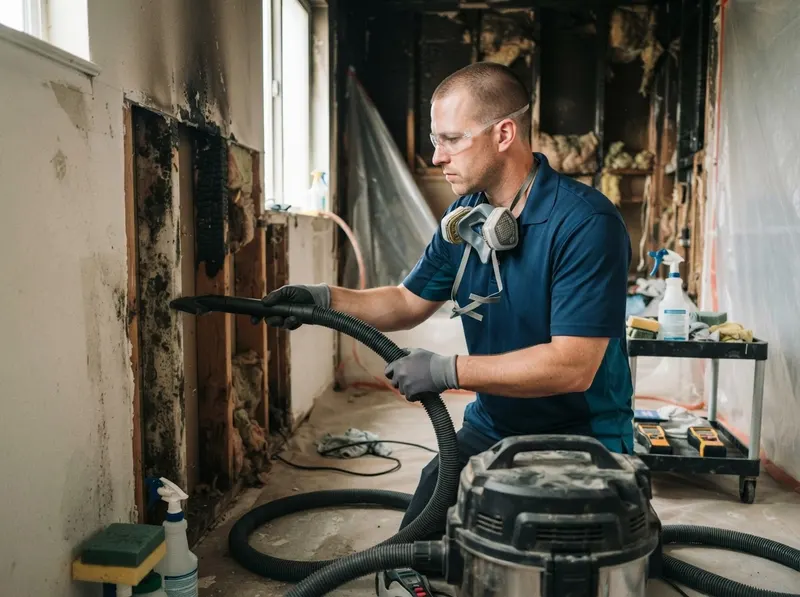
When engine companies knock down structure fires in Los Angeles neighborhoods like Studio City, Silver Lake, or Echo Park, municipal ladder trucks and hose lines deposit upwards of 500 to 3,000 gallons of water into roofing cavities, attics, and internal wall assemblies. While the active flames are extinguished within hours, this high-volume water saturates insulation, framing, and plaster. In the warm microclimates of the San Fernando Valley and the coastal marine layer influence in Pacific Palisades or Brentwood, relative humidity trapped inside a charred envelope accelerates mold spore germination within 24 to 48 hours. Secondary mold remediation after fire suppression isolates these flooded envelopes before mycotoxins and fungal colonies cross-contaminate unaffected living spaces.
Operational triage requires distinguishing between fire-scorched framing and moisture-saturated organic materials that host active colonies. If standard structural timber experiences surface charring under 1/4 inch, technicians can dry and media-blast the framing; if drywall and fiberglass insulation remain waterlogged past 48 hours beneath soot deposits, microbial colonization occurs, requiring controlled non-salvageable material removal under negative pressure. Standard post-fire odor control often fails if technicians treat for smoke without executing complete microbial remediation, as moisture trapped behind soot-sealed framing breeds Penicillium and Stachybotrys strains beneath the carbon crust.
Field operations follow a strict technical progression. Step 1 establishes critical containment barriers using 6-mil flame-retardant poly sheeting and commercial HEPA air filtration units generating 0.02 inches of water column negative pressure, isolating work zones from adjacent rooms. Step 2 conducts calibrated moisture mapping using pin and pinless moisture meters alongside infrared thermography to trace fire-water paths through subterranean slabs in Cheviot Hills or subfloors in multi-level Los Feliz homes. Step 3 extracts standing water and removes contaminated structural finishes down to bare studs under ANSI/IICRC S520 remediation standards. Step 4 deploys commercial desiccant or LGR dehumidifiers to pull moisture content in structural members below 15% before final EPA-registered botanical antimicrobial fogging and clearance sampling.
Every job gets a firm, written price after a free on-site visit.
Tell us about your secondary mold remediation after fire suppression job in los angeles and we'll send a clear, written quote, usually the same day.
 Pro Fire Damage Restoration